Showing posts with label unexploded ordnance. Show all posts

Tuesday, 24 March 2015

Uncovering Unexploded Ordnance

Today we woke up to reports of a huge unexploded World War II bomb being identified at a building site in Southwark, south London.

With households within the vicinity evacuated while the Army manages the safe removal of the device, it highlights the importance of undertaking Unexploded Ordnance (UXO) assessments at the outset of any building development works, as the probability of identifying UXO originating from the Second World War might not be as uncommon as you think.  

According to the Construction Industry Research and Information Association (CIRIA), between 2006 and 2009, approximately 15,000 devices were removed from construction sites – of which 5% were live.

Add to this, it has been reported that during WWII over 17,000 tonnes of explosive fell on London alone, with figures suggesting that approximately 10% did not detonate on impact. 

Site Assessments:

Help is available to the construction industry: the first port of call is a desktop tool called a Preliminary UXO Risk Assessment. It quickly provides a 'yes/no' answer as to whether there is any risk of encountering a bomb. It has been developed in line with guidance from CIRIA and endorsed by the Health and Safety Executive.

If a positive ‘yes’ output is identified, the next stage of assessment is to conduct a Detailed UXO Risk Assessment. This will detail the type of threat, the size, origin and also takes into account the proposed construction method and how that would impact on risk of detonation.  Risk mitigation measures are then provided to allow construction to proceed.

The ‘Bomb Search’ assessments are available from Envirocheck, part of Landmark Information Group, and are provided by renowned experts in the field of UXO, 6 Alpha Associates.
 Envirocheck Bombsearch - 6 Alpha Associates

Talking about the potential risks, Simon Cooke, Managing Director at 6 Alpha Associates, in partnership with Landmark Information Group, said:

“Encountering an unexploded bomb on a construction site is a low probability but extremely high consequence event, particularly when you take into account potential loss of life. Not to mention shock waves which could spread underground for some distance, causing damage to foundations and other underground works.   As we see it, it is the potential consequence, rather than the probability, which really drives the importance of undertaking detailed risk assessments before any work starts.”

Ultimately, at the start of any new ground works project, the first stage Preliminary search is a must. While the potential risk may be considered small, it is clear it should not be overlooked for the ultimate safety of all concerned.

More details regarding Envirocheck Bomb Search can be found here:

More details regarding 6 Alpha can be found here:

Related News Link:

Thursday, 5 June 2014

Unexploded Ordnance – is your site at risk?

In the latest issue (105) of Construction and Civil Engineering David Mole, Business Development Director at Landmark Information Group, explains the importance of incorporating unexploded ordnance risk assessments as part of Phase I site investigations.
 

It is almost 70 years since the end of World War II, yet Unexploded Ordnance (UXO) continues to pose a risk across the UK. It is estimated that 10 per cent of bombs dropped on London alone failed to detonate and could therefore pose a threat if unearthed.

Add to this the recent turbulent weather conditions, and we have seen a peak in the number of unexploded devices that have been unearthed as a result of the floods.   In fact, it has been reported that since the middle of December 2013 to the end of February, the Royal Navy’s Southern Dive Unit recovered or disposed of 244 items of ordnance.

When planning a new construction or civil engineering project, it is therefore important to incorporate UXO risk assessments as part of the Phase I site investigations to determine whether any potential risks may be present. 

Read more 

Monday, 10 March 2014

“Bombs Away” - Understanding unexploded ordnance risks

Over 60 environmental consultants and property professionals joined our recent webinar with 6 Alpha: “Bombs Away” - Understanding unexploded ordnance risks.  David Mole, Business Development Director at Landmark commented: “around 12% of the entire UK landmass has been used for military training and over 15,000 items of ordnance were found in UK construction sites between 2006 and 2009.  Our free webinar provided our clients with an overview of the source of UXO risk, and steps they can take to minimise risk.”

During WWI and WWII thousands of tonnes of high explosives were dropped on the UK, with 17,000 tonnes falling on London alone.  Approximately 10% of the air delivered bombs failed to explode (6 Alpha Associates), resulting in an underground unexploded hazard which remains to this day.   Other large cities that have been affected are Portsmouth, Plymouth Birmingham, Bristol, Manchester, Newcastle and many others.

Even today, these munitions still present a significant hazard, with the news often featuring reports of bombs being found in the construction environment  and washed up on the beach.  Unexploded ordnance risk is also caused by military sites, active explosive sites and weapons and ammunition manufactures.  An analysis of our data archives identified 600 historical and active explosive sites in the UK and over 1,000 weapons and ammunition manufacturers.

Simon Cooke, Managing Director at 6 Alpha Associates, described the steps necessary to reduce the risk associated with unexploded ordnance to a level that is as low as reasonably practical (ALARP).

Simon commented: “At the start of any new ground works project, the first stage Preliminary search is a must. While the potential risk may be considered small, it should not be overlooked for the ultimate safety of all concerned.”

The first step to analysing potential risk is a desktop tool called a Preliminary UXO Risk Assessment, which indicates whether there is any risk of encountering a bomb. It's a quick and relatively cost effective option, developed in line with guidance from CIRIA and endorsed by the Health and Safety Executive.

If the  Preliminary UXO Risk Assessment suggests a risk to the project, the next step is to conduct a Detailed UXO Risk Assessment. This will detail the type of threat, the size, origin and also takes into account the proposed construction method and how that would impact on risk of UXO being encountered including project delay and prospectively a detonation event.  Strategic risk mitigation measures are described enabling investigative/groundworks and/or groundworks to safely proceed.


Read more about Envirocheck Bomb Search.

Landmark Information Group offer a range of free webinars and training sessions.  For more information or to arrange a free training session please contact customerservice@envirocheck.co.uk

Monday, 24 February 2014

The unforeseen consequences of tidal surges and winter storms

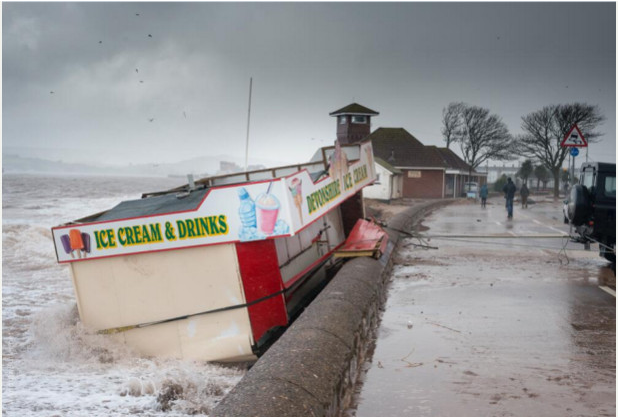
As a rule, the only inherent dangers in promenading and eating an ice cream are seagull attacks and a spike in your delicious waffle cone calorie intake. Recent severe weather conditions and tidal/storm surges have however caused all manner of chaos across the UK, and uprooted some unexpected risks. Flooding in Somerset and the North-East still persists and is having direct impact on quality of life and property with no sign of abating.  While many people are suffering in, frankly, dreadful conditions a small story (but no less terrible) caught our interest:

Exmouth sea front is a 2km stretch of sand dunes, small nature reserves and an award-winning beach.  As with all the best UK beaches it also hosts fish and chip shops and a most excellent ice cream kiosk…up until a few days ago.


Severe winds and erosion of the sandy beach displaced the entire kiosk, causing a potential hazard to shipping. Emergency work was quickly carried out to dismantle the kiosk and, in the process, an alarming discovery was made. Unexploded ordnance, thought to be a smoke grenade (used in military training exercises from around 20 years ago), was discovered under the kiosk.

It’s a bit of a leap of logic but military training in the Exmouth area is well known locally.  Lympstone barracks are less than 5km away from the town and Straight Point rifle range is only 3km along the coast.  Could it be that a training exercise on Straight Point or at Lympstone lead to the grenade falling into the sea? Could the canister have travelled on the tides only to end up washed onto the beach like some sort of weaponised message in a bottle?

Regardless of how it ended up there what this highlights is the often unforeseen consequence of storms, flood and past land use.

The team at LandmarkInformation Group can help you identify areas of both potential flood risk, as well as land used by the military in and around your property area with our extensive analysis of historic mapping - over 10,000 areas of military land identified over a range of mapping from the 1850s up until the early 2000s.  

Daniel Lewis-Carter is Data Information Co-Ordinator at Landmark Information Group.